

Landowner’s Checklist for Selling Vacant Land

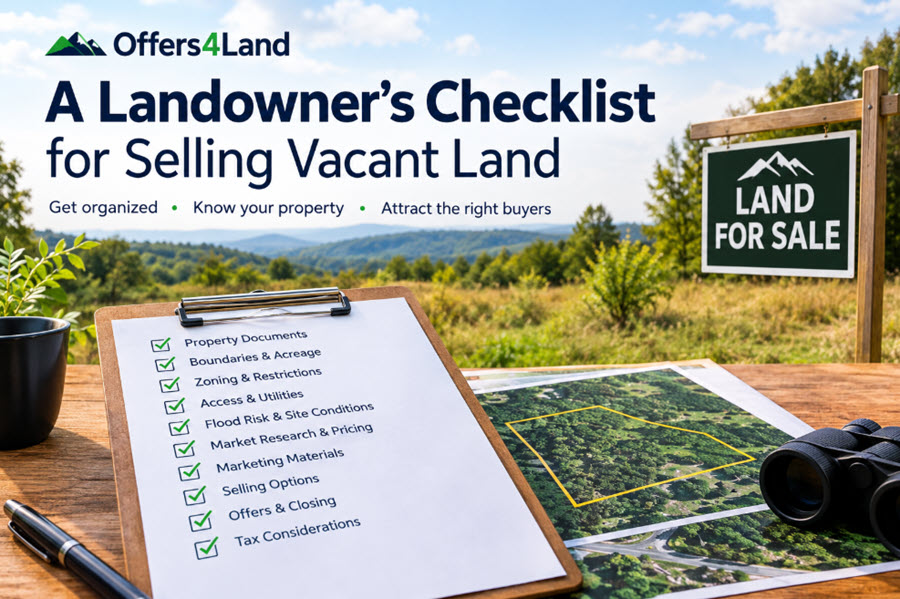
Selling vacant land can be a great way to turn an unused property into cash, reduce ongoing expenses, or move forward with other financial goals. However, selling land is not always as straightforward as selling a house. Vacant properties often have unique considerations, including access, zoning, property boundaries, utility availability, and title documentation.
Whether you own a small residential lot, several acres of rural property, or an inherited parcel you no longer need, preparing before you sell can help you avoid unnecessary delays and attract serious buyers.
The good news is that you do not need to complete every possible improvement before putting your land on the market. What matters most is understanding what you own, gathering accurate information, setting a realistic price, and choosing a selling strategy that fits your goals.
Use this landowner’s checklist to prepare your property for sale and move through the process with greater confidence.
1. Gather Your Property Documents
Before advertising your land, collect the documents that help establish ownership and identify the property. Having these records organized can make it easier to answer buyer questions and prepare for closing.
Start by gathering the following:
- Property deed: Locate the deed showing your ownership and the property’s legal description.
- Parcel number: Find the assessor’s parcel number, also called an APN in many states.
- Property tax records: Check your latest tax bill and determine whether any taxes are outstanding.
- Plat map or parcel map: Obtain an available map showing the parcel’s location and recorded boundaries.
- Purchase records: Keep any documents showing when and how you acquired the land, including the purchase price.
- Existing agreements: Collect relevant easement documents, access agreements, leases, or recorded restrictions.
If you inherited the property, recently transferred ownership, or share ownership with other people, confirm that the person or people signing the sale have the legal authority to do so.
You can usually begin by contacting the county recorder, register of deeds, or property assessor in the county where the land is located.
Checklist: ☐ Deed located ☐ Parcel number confirmed ☐ Tax records reviewed ☐ Available maps collected ☐ Ownership questions addressed

2. Verify the Property Boundaries and Acreage
Knowing the approximate location of your land is helpful, but buyers may need more precise information before committing to a purchase.
Review the recorded legal description and available parcel maps. Confirm the property’s stated acreage and identify its location relative to nearby roads, neighboring properties, and recognizable landmarks.
Keep in mind that online parcel maps are generally useful for locating a property, but they should not automatically be treated as a substitute for a professional land survey.
If boundary lines are unclear, neighboring owners disagree about a boundary, or a buyer needs verified measurements, consider consulting a licensed land surveyor.
A current survey may not be necessary for every vacant land sale, so weigh the potential expense against the property’s value and the needs of likely buyers.
You should also identify any known easements, rights-of-way, or encroachments that could affect the property. These may influence where a buyer can build, how they access the parcel, or how they use it.
Checklist: ☐ Acreage reviewed ☐ Legal description available ☐ Parcel map located ☐ Known boundary issues identified ☐ Survey needs evaluated
3. Check Zoning, Land Use Rules, and Restrictions
One of the most important questions buyers ask is what they can do with the land.
A parcel that appears ideal for a home, manufactured house, recreational property, or agricultural use may be subject to zoning rules or other restrictions. Never assume that vacant land is automatically buildable or unrestricted.
Contact the local planning or zoning department to ask about the property’s current zoning designation and permitted uses.
Depending on the location, relevant questions may include:
- Is residential construction permitted?
- Are manufactured or mobile homes allowed?
- Are recreational vehicles or campers permitted for temporary or long-term use?
- Is agricultural activity allowed?
- Are there minimum lot sizes or building setbacks?
- Are there subdivision restrictions, deed restrictions, or homeowners association rules?
- Are there special requirements for commercial development?
Remember that zoning and private deed restrictions are not the same thing. A use permitted by local zoning may still be limited by a recorded covenant or other applicable restriction.
For general information about federal land-use and environmental considerations, visit the U.S. Environmental Protection Agency.
For parcel-specific answers, the relevant county or municipal office is usually the best starting point.
Checklist: ☐ Zoning identified ☐ Intended uses checked ☐ Known restrictions reviewed ☐ HOA requirements checked, if applicable
4. Confirm Road Access and Utility Availability
Access and utilities can significantly influence how attractive a vacant parcel is to potential buyers.
A property may appear close to a road on a map, but that does not necessarily mean it has legally established access. Similarly, nearby utility infrastructure does not guarantee that services are available at the property line or that connecting to them will be inexpensive.
Review the following:
Road access: Determine whether the parcel fronts a public road or relies on a private road or recorded easement. If access crosses another person’s land, verify the relevant legal arrangements.
Electricity: Check whether power lines or service connections are nearby. Ask the utility provider about connection requirements and potential costs.
Water: Find out whether public water service is available or whether a private well may be necessary. Nearby water lines do not automatically mean a connection is possible.
Sewer and septic: Determine whether public sewer service is available. If the property may require a septic system, contact the appropriate local health or environmental department about soil evaluations, permits, and site suitability.
Internet and other services: Where relevant, check whether internet, natural gas, or other services are available.
Be specific in your listing. Instead of simply stating that utilities are available, explain what you have actually verified. For example, you might say that electricity is nearby, public water availability has not been confirmed, and the buyer should verify connection costs.
This approach helps establish realistic expectations and reduces misunderstandings later.
Checklist: ☐ Legal access reviewed ☐ Electric availability checked ☐ Water source investigated ☐ Sewer or septic requirements reviewed ☐ Utility connection costs considered
5. Investigate Flood Risk, Wetlands, and Site Conditions
Physical characteristics can affect the land’s value, usability, and potential development costs.
Before listing, review any information you have about flooding, drainage, steep slopes, wetlands, soil conditions, or other site limitations.
The FEMA Flood Map Service Center allows users to look up official flood hazard mapping information for specific locations. This is a useful starting point for understanding mapped flood risks, although a map review is not a guarantee that a property will never flood.
Other considerations include:
- Whether the property contains wetlands or protected environmental features.
- Whether the terrain may require grading or other site preparation.
- Whether the soil may be suitable for a proposed septic system.
- Whether drainage patterns could affect construction.
- Whether there are known environmental concerns or previous uses that require further investigation.
If you have reports from prior soil tests, septic evaluations, environmental assessments, or engineering studies, organize them for potential buyers.
Do not advertise the land as buildable, flood-free, or suitable for a particular use unless you have a reasonable basis for that statement.
You do not necessarily need to commission every possible test before selling. Instead, identify what is known, what remains unverified, and which questions a buyer should investigate.
Checklist: ☐ Flood maps reviewed ☐ Known site issues documented ☐ Existing test results gathered ☐ Unverified conditions clearly identified
6. Research the Market and Set a Realistic Asking Price
Pricing vacant land requires a different approach from pricing a home. Two parcels with similar acreage may have very different values because of their locations, access, zoning, terrain, and development potential.
Start by researching comparable land sales in the same area. Look for properties that are reasonably similar in acreage, permitted use, access, utility availability, and general condition.
Useful sources include county property records, recent comparable sales, land listing websites, and local real estate professionals with experience in vacant land.
When comparing properties, consider:
- Location: Proximity to towns, employment centers, recreation, or desirable neighborhoods.
- Size and shape: Acreage, frontage, and whether the parcel’s shape limits potential uses.
- Access: Whether buyers can legally and practically reach the property.
- Utilities: Availability and cost of connecting essential services.
- Restrictions: Zoning, deed restrictions, and other limitations.
- Site conditions: Terrain, drainage, vegetation, and other physical characteristics.
- Market activity: How similar properties are priced and how long they have been listed.
Be careful not to confuse asking prices with actual sale prices. A property advertised for a particular amount has not necessarily sold for that amount.
You should also consider your own timeline. If you need to sell quickly, pricing competitively may be more effective than starting with an ambitious asking price and waiting for the right buyer.
Checklist: ☐ Comparable properties researched ☐ Recent sales reviewed ☐ Property strengths and limitations evaluated ☐ Asking price selected
7. Prepare the Land for Marketing
Vacant land does not need to look like a landscaped residential property to attract buyers. However, clear information and useful visuals can make a meaningful difference.
Start with basic preparation.
Remove trash or obvious debris if practical and safe. If overgrown vegetation prevents buyers from understanding the parcel, consider whether selective clearing would improve visibility. Avoid spending heavily on clearing, grading, fencing, or other improvements without considering whether they are likely to increase the sale price enough to justify the expense.
Next, prepare your marketing materials.
A strong land listing should include:
- A clear description of the property’s location.
- The acreage and asking price.
- A parcel map or aerial image.
- Photographs of the land and surrounding area, where available.
- Information about road access and known utilities.
- Confirmed zoning or restrictions, when available.
- Known limitations and any important due-diligence information.
- Directions or a map link that helps prospective buyers find the parcel.
If you cannot visit the property yourself, use reliable mapping resources and available property photographs, but avoid implying that you have personally inspected the land if you have not.
The goal is to help buyers understand what is being offered before they make a trip or submit an offer.
Checklist: ☐ Useful photos collected ☐ Parcel map prepared ☐ Accurate description written ☐ Important property details verified ☐ Listing materials reviewed
8. Choose the Right Way to Sell Your Land
There is no single selling method that works best for every landowner. The right option depends on how quickly you want to sell, how much effort you want to invest, and whether maximizing the sale price or simplifying the process is your priority.
Sell the land yourself
Selling independently may give you more control over pricing, communication, and negotiations. You will also be responsible for preparing the listing, responding to inquiries, evaluating offers, and coordinating the transaction.
This option may suit owners who have time to manage the process and are comfortable researching local requirements.
Hire a real estate agent
An agent familiar with vacant land may help you estimate market value, reach potential buyers, and negotiate offers. Before signing an agreement, ask about experience selling land, marketing plans, commissions, and any additional costs.
Not every agent specializes in vacant parcels, so land-specific experience matters.
Sell directly to a land buyer
Another option is to contact a company or buyer that purchases vacant land directly. Depending on the buyer and property, this approach may reduce the amount of marketing and negotiation you need to handle.
Direct buyers may prioritize a straightforward transaction, but their offers can differ from what you might achieve through a broader retail marketing campaign. Compare the proposed price, closing arrangements, fees, and timeline before deciding.
You can explore a potential sale through Offers4Land to learn more about your options for selling vacant land.
Regardless of the method, compare the expected net proceeds—not just the advertised sale price.
Checklist: ☐ Selling method selected ☐ Fees and costs reviewed ☐ Timeline considered ☐ Expected net proceeds compared
9. Review Offers Carefully
Receiving an offer is an important milestone, but the highest offer is not always the best one.
Review each proposal based on its price, contingencies, financing, closing date, and likelihood of completion.
For example, one buyer might offer more money but require extensive inspections or financing approval. Another might offer less but propose a simpler transaction with a more certain closing timeline.
Before accepting an offer, clarify:
- The purchase price and deposit arrangements.
- Whether the buyer is paying cash or using financing.
- Any inspection or due-diligence period.
- Who is responsible for closing costs and other agreed expenses.
- The proposed closing date.
- Any contingencies that could allow the buyer to cancel.
- How title issues, liens, or unpaid taxes will be handled.
Make sure all important terms are included in the written agreement. Avoid relying solely on verbal promises.
If you are considering seller financing, have a qualified real estate attorney or other appropriate professional help structure the agreement, including payment terms, default provisions, and the process for transferring ownership.
Checklist: ☐ Offer terms reviewed ☐ Buyer qualifications considered ☐ Contingencies understood ☐ Written agreement reviewed
10. Prepare for Closing and Transfer of Ownership
Once you accept an offer, the transaction moves into the closing stage.
The exact process varies by state and transaction, but a title company, closing attorney, or other qualified closing professional can help coordinate the required documents and funds.
Before closing, be prepared to address:
- Verification of legal ownership.
- Title searches and any identified title defects.
- Outstanding property taxes, liens, or other obligations.
- Preparation and signing of the deed and related documents.
- Agreed closing costs and settlement arrangements.
- Recording the deed with the appropriate county office.
If the property has multiple owners, inherited ownership complications, an existing loan, or a lien, additional steps may be necessary.
Follow the closing professional’s instructions for signing documents and receiving funds. Independently verify any changes to payment or wire-transfer instructions using a trusted contact method to help protect yourself against fraud.
Once the transaction is complete, retain copies of the signed agreement, closing statement, deed-related records, and other relevant documents.
Checklist: ☐ Title and ownership reviewed ☐ Outstanding obligations addressed ☐ Closing documents signed ☐ Funds received as agreed ☐ Records retained
11. Understand the Tax Implications
Selling vacant land may have tax consequences, particularly if the property has increased in value since you acquired it.
Your tax treatment may depend on how you acquired the property, how long you owned it, how it was used, and whether the sale produces a gain or loss. Inherited land, investment property, and land held as part of a business may involve different considerations.
Keep records of your original purchase price, eligible acquisition costs, qualifying improvements, and sale-related expenses. These records may be relevant when determining your tax basis and calculating any gain or loss.
The IRS provides guidance in Publication 544: Sales and Other Dispositions of Assets.
For advice specific to your situation, consult a qualified tax professional. Do not assume that the entire sale price is taxable income or that a particular exclusion or deduction automatically applies.
Checklist: ☐ Purchase records retained ☐ Relevant expenses documented ☐ Tax implications considered ☐ Professional advice obtained if needed
Your Complete Vacant Land Selling Checklist
Before moving forward, use this quick review to see whether you are ready to market your property.
-
I have located my deed and confirmed ownership.
-
I know the parcel number, approximate acreage, and legal description.
-
I have reviewed the available parcel map and any boundary concerns.
-
I have investigated zoning and known restrictions.
-
I understand the property’s access and utility situation.
-
I have reviewed available information about flood risk and site conditions.
-
I have researched comparable properties and selected an asking price.
-
I have prepared accurate listing information and useful photos or maps.
-
I have compared my selling options and expected net proceeds.
-
I understand the offer, closing, and tax considerations involved.
You do not have to resolve every unknown before listing your property. However, being transparent about what you know—and what still needs to be verified—can help you attract better-informed buyers and reduce avoidable surprises.
Final Thoughts: Make Your Next Land Sale Simpler
Selling vacant land can feel complicated when you are unsure where to begin. A little preparation goes a long way: organize your documents, understand your property’s characteristics, research the market, and choose a selling strategy that matches your priorities.
Most importantly, remember that you do not have to make expensive improvements or undertake every possible investigation before exploring your options. Start with the information you already have, identify any significant gaps, and decide which next steps make financial sense for your property.
Ready to explore selling your vacant land?
At Offers4Land, you can take the next step toward finding a potential buyer for your property. Whether you own a small residential lot or a larger rural parcel, exploring your selling options can help you decide how to move forward.
Visit Offers4Land today to learn more about your options and take the first step toward turning your unused land into an opportunity.
Disclaimer: This article is for general informational purposes only and is not legal, tax, surveying, or real estate advice. Requirements vary by state, county, and property. Verify parcel-specific information with the appropriate local authorities and qualified professionals before completing a sale.
Want help selling your land?
At Offers4Land.com, we specialize in buying and marketing vacant land across the U.S. Whether you own a small residential lot or a large rural acreage, we can help you sell with ease and peace of mind. Also Find us on Facebook.
