

How to Prepare Your Land Listing Before You Start Advertising

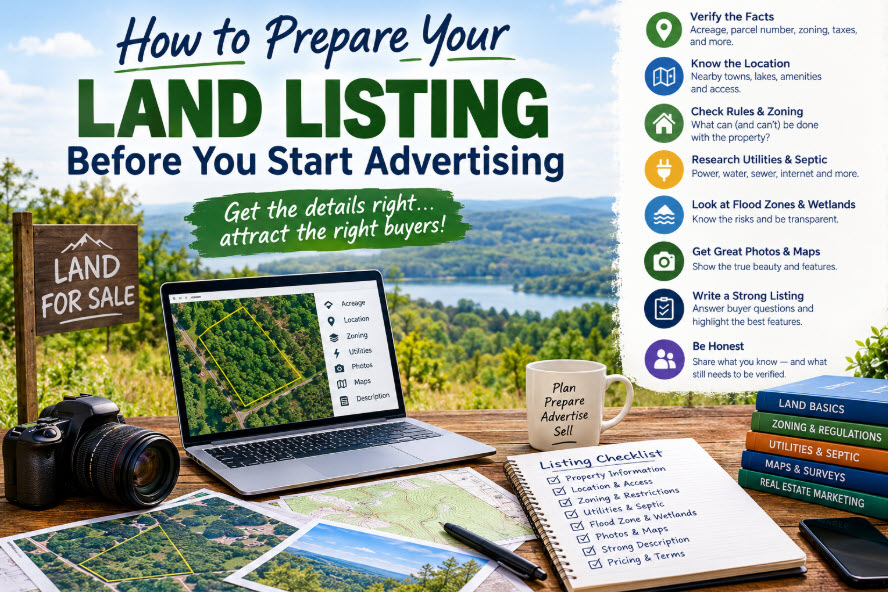
Selling vacant land is different from selling a house. A home buyer can usually walk through the property, see the kitchen, bedrooms, bathrooms, and other features, and quickly understand what they are buying.
With vacant land, the buyer has to imagine the possibilities.
That makes your land listing especially important.
Before you publish your property on a land marketplace, social media, classified website, or your own website, take time to prepare the information, photos, maps, and details a buyer will need. A well-prepared listing can attract more qualified buyers, reduce repetitive questions, and help your property stand out from hundreds of other land listings.
Whether you are selling a small residential lot, recreational acreage, farmland, hunting property, or an unrestricted parcel, here is how to prepare your land listing before you start advertising.
1. Verify the Basic Property Information
Start with the facts.
Before writing an attractive description, make sure the basic information about the property is accurate.
At a minimum, gather:
- Property address or nearest physical address
- County and state
- Parcel number or APN
- Acreage
- Legal description
- Lot dimensions, if available
- Zoning
- Property taxes
- Road access
- Ownership information
- Asking price
- Financing terms, if offered
The parcel number is particularly useful because buyers may use it to research the property through county records.
Do not guess the acreage, zoning, road access, or other important facts just because another website lists them. Public records and mapping systems can contain outdated or incomplete information.
If you are unsure about an important detail, verify it before advertising.
Accuracy builds trust.
2. Confirm the Property’s Location
Location is one of the most important parts of a land listing.
Instead of simply saying:
“Beautiful 2-acre property in Alabama.”
Give buyers enough information to understand where the property is located.
For example:
“This 2-acre parcel is located in Walker County, Alabama, approximately 15 minutes from Jasper and about 20 minutes from Smith Lake.”
Useful location information can include:
- City or town
- County
- State
- Nearest major highway
- Nearby towns
- Nearby lakes, rivers, parks, or public land
- Grocery stores
- Hospitals
- Schools
- Major employment areas
- Airports
- Popular recreational destinations
However, avoid exaggerating distances. If you say a property is “10 minutes from the lake,” make sure that estimate is reasonable.
A buyer may check the distance themselves, and inaccurate claims can quickly damage your credibility.
3. Check Zoning and Land-Use Rules
One of the biggest mistakes land sellers make is advertising what a buyer could potentially do without confirming whether local regulations actually allow it.
Before you advertise, investigate the property’s zoning and applicable county or city regulations.
Depending on the property, buyers may want to know whether they can:
- Build a house
- Build a cabin
- Place a manufactured home
- Place a mobile home
- Park an RV
- Camp
- Use the property recreationally
- Farm or raise livestock
- Build multiple structures
- Subdivide the parcel
- Operate a business
Rules can vary dramatically from one county to another.
If you have confirmed that there are no known deed restrictions or HOA restrictions, you can explain that clearly. But be careful with statements such as “no restrictions” unless you understand exactly what that means.
“No HOA” does not necessarily mean “no zoning.”
Likewise, a seller’s understanding of a property does not replace confirmation from the appropriate county or municipal authority.
A good listing can say:
“Seller is not aware of private deed restrictions. Buyers should independently verify zoning, building requirements, septic requirements, and permitted uses with the county.”
That gives buyers useful information without making promises you cannot guarantee.
4. Research Utilities Before Advertising
Utilities are among the first questions serious land buyers ask.
Try to determine the availability of:
- Electricity
- Public water
- Sewer
- Natural gas
- Internet
- Telephone
- Well water options
- Septic options
Be precise with your wording.
There is a major difference between:
“Electricity is available.”
and
“Power is at the property.”
If you only know that an electric line is nearby, say so.
For example:
“Electricity appears to be available near the property; buyer should contact the local utility provider to confirm connection requirements and costs.”
The same principle applies to water.
If there is no public sewer, don’t simply write “sewer available” because a nearby property has sewer. Instead, research whether the parcel can connect or whether a septic system would likely be necessary.
5. Research Septic and Soil Information
For rural land, septic information can make a major difference.
Buyers often want to know whether a property has:
- Existing septic
- A previous perc test
- A septic permit
- Suitable soils
- Public sewer
- A known septic site
If a perc test has never been performed, say that.
Do not advertise:
“This property will definitely perk.”
unless you have documentation supporting that statement.
You can research general soil information through the USDA Natural Resources Conservation Service’s Web Soil Survey, which provides soil maps and related information for land-use planning. The USDA also notes that onsite investigation may still be necessary for certain detailed applications.
This information can be helpful when preparing your listing, but it should not be presented as a substitute for a professional site evaluation or official septic approval.
6. Check Flood Zones and Wetlands
Flood risk is another important consideration for vacant land.
Before advertising, determine whether the property is located in a flood zone or whether there are other environmental considerations buyers should know about.
The FEMA Flood Map Service Center is an important resource for researching official flood mapping information.
If you discover that a portion of the property is in a flood zone, don’t hide it. Instead, explain what you know and encourage the buyer to conduct their own due diligence.
The same applies to wetlands.
If a map shows a possible wetland area, describe it carefully rather than claiming the entire property is unusable.
Transparency can actually make your listing stronger because serious buyers appreciate knowing potential issues before they spend time traveling to the property.
7. Confirm Road Access
A beautiful parcel is much less attractive if a buyer cannot legally or practically reach it.
Before advertising, investigate:
- Is the property on a public road?
- Is the road paved or dirt?
- Is there a recorded access easement?
- Is the road maintained?
- Is the property landlocked?
- Is there physical access?
- Is four-wheel drive recommended?
- Does the road become difficult during wet weather?
Never confuse physical access with legal access.
A road may physically lead to the property without providing the buyer with a clear legal right to use it.
If you are uncertain about legal access, investigate the deed, title records, easements, and county information before making a definitive statement.
8. Get Good Property Photos
Photos are one of the biggest factors affecting whether someone clicks on your listing.
For vacant land, you should provide more than one or two random photographs.
Try to capture:
- Front of the property
- Road frontage
- Property entrance
- Interior views
- Trees and vegetation
- Terrain
- Nearby water
- Views
- Trails
- Fencing
- Neighboring development
- Utility lines, when relevant
Take photos during daylight and avoid blurry or heavily edited images.
If possible, visit the property after checking the weather. A clear day can make a significant difference.
Most importantly, do not use photographs that make the property look substantially different from reality.
If the land is heavily wooded, show the woods. If the terrain is steep, don’t only show the flattest section.
Your goal is not simply to make someone click.
Your goal is to attract a buyer who will still like the property after visiting it.
9. Create a Clear Parcel Map
A good map is essential for vacant land.
Many buyers cannot understand the location of a property from an address alone.
Consider providing:
- Parcel boundary map
- Road frontage
- Nearby roads
- Neighboring parcels
- Approximate dimensions
- GPS location
- Nearby landmarks
- Aerial imagery
You can also provide a separate map showing the property’s location relative to the nearest town or major attraction.
For larger rural properties, a topographic map can be particularly useful because elevation and terrain may strongly affect how the property can be used.
The U.S. Geological Survey provides free US Topo maps and other mapping resources through its National Geospatial Program. USGS topographic maps show terrain and elevation using contour lines and can help buyers understand the landscape.
For especially useful marketing materials, consider creating a simple aerial parcel map with the property boundary clearly marked.
10. Research Internet Availability
Internet access may not be the first thing you think about when selling land, but it can matter significantly to today’s buyers.
People looking for rural property may be interested in:
- Remote work
- Full-time living
- Vacation property
- Homesteading
- Camping
- Building a home
The FCC’s National Broadband Map allows users to search locations and see reported broadband providers, technologies, and advertised speeds.
Use this as a research tool, but remember that actual service availability and installation costs should be confirmed directly with providers.
11. Identify the Best Buyer for the Property
Before writing your headline, ask:
Who is most likely to buy this land?
Different properties attract different buyers.
For example:
Small residential lot
Potential buyers may be:
- First-time land buyers
- Homebuilders
- Investors
- People looking for an affordable homesite
Large rural acreage
Potential buyers may be:
- Homesteaders
- Farmers
- Hunters
- Recreational buyers
- Families wanting privacy
Waterfront property
Potential buyers may be interested in:
- Recreation
- Fishing
- Vacation homes
- Cabins
- Investment
Understanding your target buyer helps you write a much stronger listing.
12. Write a Strong Listing Title
Your title should communicate the property’s strongest selling points quickly.
Instead of:
“2 Acres for Sale”
try something more descriptive:
2 Acres Near Smith Lake – Rural Setting With Easy Road Access
Or:
6.9 Acres Near Bull Shoals Lake – Spacious Arkansas Property
A strong title usually combines:
Acreage + Location + Main Benefit
Avoid stuffing the title with unnecessary keywords.
The goal is to make the right buyer want to learn more.
13. Build the Description Around Buyer Questions
A good land description should answer the questions buyers are most likely to ask.
A useful structure is:
Opening
Explain what makes the property interesting.
Location
Explain where it is and what’s nearby.
Property Details
Include acreage, terrain, road access, and general setting.
Utilities
Explain what is known about power, water, sewer, septic, and internet.
Restrictions and Zoning
Explain known restrictions and encourage buyers to verify regulations.
Possible Uses
Describe realistic potential uses without guaranteeing approval.
Pricing
Clearly state the cash price and financing terms if available.
Due Diligence
Explain that buyers should independently verify information important to their intended use.
14. Be Honest About What You Don’t Know
This may sound counterintuitive, but admitting what you don’t know can make a listing more credible.
For example:
“No recent survey is available.”
“No perc test has been completed.”
“Buyer should verify RV use with the county.”
“Utilities are nearby; buyer should confirm connection costs.”
These statements are much better than making an unsupported promise.
Land buyers understand that vacant properties often require due diligence.
Your job as the seller is to provide the information you actually have and clearly identify what still needs to be verified.
15. Prepare a Due-Diligence Information Package
Before advertising, create a folder containing everything you have about the property.
This could include:
- Deed
- Tax information
- Parcel map
- Survey, if available
- Previous survey
- Perc test
- Septic permit
- Zoning information
- HOA documents
- Restriction documents
- Utility information
- Flood map
- Photos
- GPS coordinates
- Directions
- Financing terms
You may not need to publish every document publicly, but having them organized makes it much easier to respond quickly when a serious buyer asks questions.
 16. Calculate the True Selling Price
Before advertising, decide exactly what price you want to advertise.
Research comparable properties in the same area and consider:
- Acreage
- Location
- Road access
- Utilities
- Terrain
- Zoning
- Restrictions
- Waterfront access
- Development potential
- Nearby amenities
- Recent comparable sales
Don’t automatically price your property based on another listing’s asking price. An asking price is not necessarily the same as the price a buyer is willing to pay.
If you offer owner financing, calculate the terms carefully.
Clearly state:
- Down payment
- Monthly payment
- Number of payments
- Interest rate, if applicable
- Total purchase price
- Closing costs
- When ownership transfers
17. Create a Listing Checklist Before Publishing
Before your listing goes live, run through a final checklist.
Property Information
- Acreage verified
- County verified
- Parcel number verified
- Address or location confirmed
- Price confirmed
- Financing terms confirmed
Property Details
- Zoning researched
- Restrictions researched
- Road access checked
- Utilities researched
- Septic/perc information checked
- Flood zone researched
- Wetlands researched where applicable
- Internet availability researched
Marketing
- High-quality photos uploaded
- Parcel boundary map prepared
- Location map prepared
- Strong title written
- Description completed
- Nearby amenities included
- Directions prepared
- Contact information included
Buyer Experience
- Important limitations disclosed
- Unknown information clearly identified
- Buyer due diligence statement included
- Questions from previous buyers addressed
Final Thoughts: Prepare First, Advertise Second
The best land listings are not necessarily the ones with the most dramatic headlines.
They are the listings that make buyers feel like they understand the property.
Before you advertise your land, take the time to verify the facts, research zoning and access, investigate utilities, prepare accurate maps, take useful photographs, and clearly explain what you know—and what still needs to be verified.
Remember that vacant land requires buyers to visualize the future. Your listing should make that process easier.
A buyer should be able to look at your listing and quickly answer:
Where is it? How big is it? How do I access it? What can I potentially do there? What utilities are available? What restrictions exist? What is nearby? How much does it cost? And what should I verify before buying?
If your listing answers those questions clearly, you are already ahead of many competing land sellers.
And once the property is properly prepared, you can confidently advertise it across land marketplaces, your website, social media, email campaigns, and other marketing channels.
Prepare the property. Prepare the information. Prepare the buyer. Then start advertising.
Want help selling your land?
At Offers4Land.com, we specialize in buying and marketing vacant land across the U.S. Whether you own a small residential lot or a large rural acreage, we can help you sell with ease and peace of mind. Also Find us on Facebook.
